Education has always been one of the strongest foundations of India's growth. From traditional learning methods to modern classrooms equipped with digital technology, the country has experienced remarkable changes in how children learn and develop.
The education system in India plays an important role in shaping young minds, developing essential skills, and preparing students for future opportunities. However, education today is not just about completing textbooks or scoring high marks. It is about encouraging curiosity, building confidence, developing creativity, and helping children become responsible individuals.
With changing career opportunities, technological advancements, and educational reforms, schools are gradually moving towards a more balanced approach to learning.
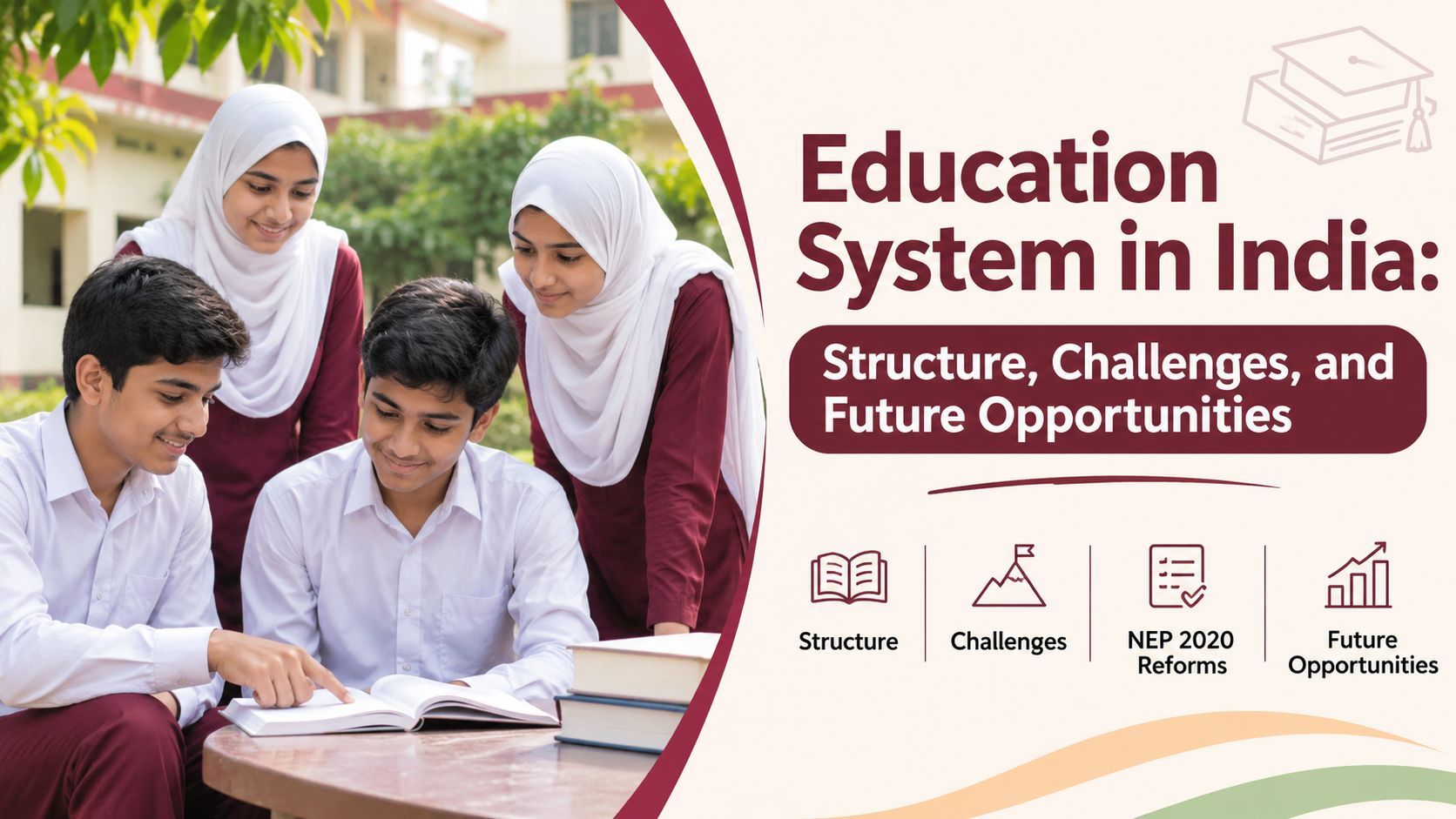
In this blog, we will explore the structure of the Indian education system, its major challenges, the impact of the National Education Policy 2020, and how schools can help students prepare for a brighter future.
The education system in India is a structured framework designed to provide learning opportunities to children and young adults at different stages of their lives. It includes early childhood education, primary and secondary schooling, higher education, and vocational training.
India has a diverse educational landscape consisting of government schools, private schools, and institutions operating under different educational boards.
Some commonly recognised school boards include:
CBSE (Central Board of Secondary Education): Offers a nationally recognised curriculum.
CISCE (Council for the Indian School Certificate Examinations): Conducts ICSE and ISC examinations.
State Boards: Provide education according to the curriculum and requirements of individual states.
While teaching approaches and curricula may vary, the common objective remains the same: helping students gain knowledge, develop skills, and become capable members of society.
Today, quality education in India increasingly focuses on practical understanding, communication skills, creativity, and personal development alongside academic performance.
The traditional Indian school system is commonly understood through pre-primary, primary, upper-primary, secondary, and higher-secondary education.
However, the National Education Policy 2020 introduced a new 5+3+3+4 educational structure, designed to align learning with children's developmental stages.
This five-year stage includes three years of preschool or Anganwadi education and Classes 1 and 2.
Children learn through storytelling, games, music, creative activities, and interaction.
The objective is to develop basic reading, writing, numerical understanding, communication, and social skills.
This stage covers Classes 3 to 5.
Students gradually move towards structured classroom learning while continuing activity-based education.
Subjects such as mathematics, languages, environmental studies, and creative arts help strengthen their academic foundation.
Classes 6 to 8 form the middle stage.
At this level, students begin developing a deeper understanding of subjects through discussions, experiments, projects, and problem-solving activities.
The focus shifts towards developing critical thinking and applying knowledge in everyday situations.
The secondary stage includes Classes 9 to 12.
Students explore academic subjects in greater depth while preparing for higher education, vocational opportunities, and future careers.
The policy encourages greater flexibility and learning choices so that students can identify their interests and strengths.
This framework is intended to make school education in India more engaging, inclusive, and suited to children's learning needs.
Education contributes to both individual growth and national development. It helps students gain the knowledge and confidence required to make informed decisions and pursue meaningful opportunities.
Here are some important ways education transforms lives.
Education encourages students to explore new ideas, ask questions, and understand the world around them. It builds a strong academic foundation that supports lifelong learning.
A quality education helps students develop the academic knowledge, communication abilities, and practical skills necessary to explore different career paths.
Classroom discussions, presentations, competitions, and extracurricular activities encourage children to express themselves confidently.
Schools play an essential role in teaching honesty, discipline, empathy, respect, and social responsibility.
Educated individuals contribute to innovation, entrepreneurship, economic progress, and stronger communities.
The importance of education in India extends beyond academic achievement. It is also about nurturing thoughtful, responsible, and confident citizens.
Despite significant progress, the Indian education system continues to face challenges that affect learning experiences and educational opportunities.
Students living in different regions may not have equal access to experienced teachers, educational resources, modern facilities, and learning opportunities.
Improving educational accessibility remains essential for ensuring that children from different backgrounds receive meaningful learning experiences.
In some classrooms, academic performance is still strongly associated with examination marks.
Although assessments are important, excessive pressure can discourage curiosity, experimentation, and independent thinking.
Students need opportunities to understand concepts rather than simply memorise information.
Textbook knowledge becomes more valuable when students can apply it in real-life situations.
Hands-on activities, experiments, projects, and group discussions can make learning more interesting and memorable.
Technology has created exciting educational opportunities, but access to devices, internet connectivity, and digital resources remains uneven.
Closing this gap is important for making modern learning tools accessible to more students.
Academic achievement alone cannot prepare students for every challenge in life.
Schools must also encourage communication, emotional well-being, teamwork, creativity, physical fitness, and problem-solving skills.
Addressing these challenges can help strengthen the overall quality of education in India.
The National Education Policy 2020 (NEP 2020) represents an important step towards making education more flexible, inclusive, and skill-oriented.
Rather than focusing only on memorisation, the policy emphasises conceptual understanding, critical thinking, creativity, and holistic development.
Some of its major priorities include:
Foundational literacy and numeracy: Strengthening children's reading and mathematical abilities during the early years.
Experiential learning: Encouraging activities, projects, experiments, and practical learning.
Flexible subject choices: Supporting broader learning opportunities across academic disciplines.
Vocational exposure: Helping students understand practical skills and different career possibilities.
Multilingual learning: Recognising the educational value of Indian languages and children's home languages.
Holistic assessment: Encouraging evaluation methods that reflect different aspects of student development.
These reforms are being introduced progressively, and implementation may differ across states, school boards, and institutions.
Parents interested in understanding the reforms can explore the National Education Policy 2020 published by the Ministry of Education.
Technology is changing how students access information and interact with educational content.
Digital classrooms, educational videos, interactive exercises, and online learning platforms can make difficult concepts easier to understand.
For example, a student learning about the solar system may understand planetary movement more clearly through an interactive animation than through a textbook illustration alone.
Similarly, digital quizzes can help teachers assess understanding and identify areas requiring additional attention.
However, technology works best when combined with teacher guidance, classroom discussions, and practical activities.
Schools should also help children develop responsible digital habits, including appropriate screen time, internet safety, and balanced technology use.
The future of education in India will depend not only on adopting technology but also on using it thoughtfully to improve learning outcomes.
Every child has different abilities, interests, and aspirations.
Some students perform exceptionally well in mathematics or science, while others discover their strengths through sports, music, art, writing, or leadership activities.
A balanced educational environment recognises these differences and provides opportunities for children to explore their potential.
Holistic education encourages:
Academic understanding and curiosity.
Communication and interpersonal skills.
Physical fitness and participation in sports.
Creativity and independent thinking.
Emotional awareness and self-confidence.
Moral values and responsible behaviour.
When students receive encouragement in different areas, they become better prepared to handle challenges both inside and outside the classroom.
This approach also helps children understand that success is not limited to examination results.

At Hera Public School, education is viewed as an opportunity to nurture both academic understanding and personal character.
Located in Azamgarh, Uttar Pradesh, the school emphasises modern education alongside moral values, discipline, respect, and responsibility.
Its educational philosophy, "Deen Bhi, Duniya Bhi," reflects the importance of balancing academic learning with strong ethical foundations.
The school encourages students to develop knowledge, confidence, creativity, and a sense of responsibility towards their families and communities.
Through academic learning and co-curricular opportunities, Hera Public School aims to support the overall development of its students.
Parents can learn more about the school's approach through its About Us page and explore its academic programmes.
Choosing a school that values both learning and character development can help build a meaningful foundation for a child's future.
The education system in India is gradually moving towards a future where learning is expected to become more personalised, practical, inclusive, and technology-supported.
In the coming years, several educational trends are likely to become increasingly important.
Skill-Based Learning: Students will benefit from opportunities to develop communication, collaboration, problem-solving, and practical abilities.
Greater Use of Technology: Digital educational tools may help teachers provide more interactive and personalised learning experiences.
Focus on Creativity: Project-based activities and interdisciplinary learning can encourage students to think independently.
Inclusive Education: Schools and policymakers will need to continue improving learning opportunities for children with different educational needs.
Stronger Parent-School Partnerships: Regular communication between parents and teachers can help identify children's strengths and address learning difficulties early.
As educational expectations evolve, schools that combine academic excellence with meaningful skill development and strong values will play an important role in preparing future generations.
Parents have a significant influence on children's learning habits, confidence, and motivation.
Simple everyday actions can make a positive difference.
Encourage children to read regularly, discuss what they learn at school, and ask questions without hesitation.
Provide a comfortable learning environment at home and help establish realistic study routines.
Instead of focusing only on marks, appreciate effort, improvement, creativity, and perseverance.
It is equally important to encourage outdoor activities, hobbies, family interactions, and adequate rest.
Maintaining regular communication with teachers can also help parents understand their child's academic and emotional needs.
When families and schools work together, children receive consistent encouragement to learn and grow.
The education system in India continues to evolve in response to changing social, technological, and economic needs.
While challenges such as educational inequality, examination pressure, and limited resources remain, reforms and innovative teaching approaches offer opportunities for improvement.
A meaningful education should help children gain knowledge, discover their abilities, build confidence, and develop values that guide them throughout life.
At Hera Public School, the emphasis on academic learning and character development reflects this broader purpose of education.
By encouraging both knowledge and values, schools can help students grow into confident individuals ready to contribute positively to society.
Hera Public School – Deen Bhi, Duniya Bhi.
Explore educational opportunities at Hera Public School and learn more about the admission guidelines.
Hi, everyone! Has anyone checked out [url=https://coronaverses.art/] Royal Reels Casino site[/url]? I keep seeing ads for this casino almost every day. Initially, I just scrolled past the ads without a second thought. But now I'm getting a bit curious. I haven't actually visited the site yet, though. One of my mates actually tried this casino recently. He brings up this site in conversation every now and then. He reckons it's pretty good. I figured I'd see what everyone else reckons. I'd especially like to hear from people who've actually played there. Here's the link to the site I'm asking about - https://coronaverses.art. If you've tried it, were you happy with it or did you regret it?
Ищете автомобиль? Автосалон «Федерал» предлагает машины в наличии и привоз под заказ из Кореи, Китая, Японии, Европы, ОАЭ и США. Поможем выбрать автомобиль, проверить его историю и состояние, рассчитать стоимость под ключ и оформить покупку. Возможен трейд-ин. Телефон: +7 (963) 109-93-00.
