
Have you ever sat down to study, opened your textbook, and suddenly found yourself thinking about something completely different? Maybe you started checking your phone, looking around your room, or wondering what to do after finishing your homework. Before you realise it, thirty minutes have passed, and you have barely completed a page.
This happens to many students. Staying focused can be difficult, especially when there are so many distractions around us. However, concentration is not something that only a few students are naturally good at. It is a skill that can improve with regular practice and the right habits.
If you are wondering how to improve concentration in studies, the answer is not simply to study for longer hours. It is about creating a suitable environment, managing your time, and finding study methods that help you stay interested in learning.
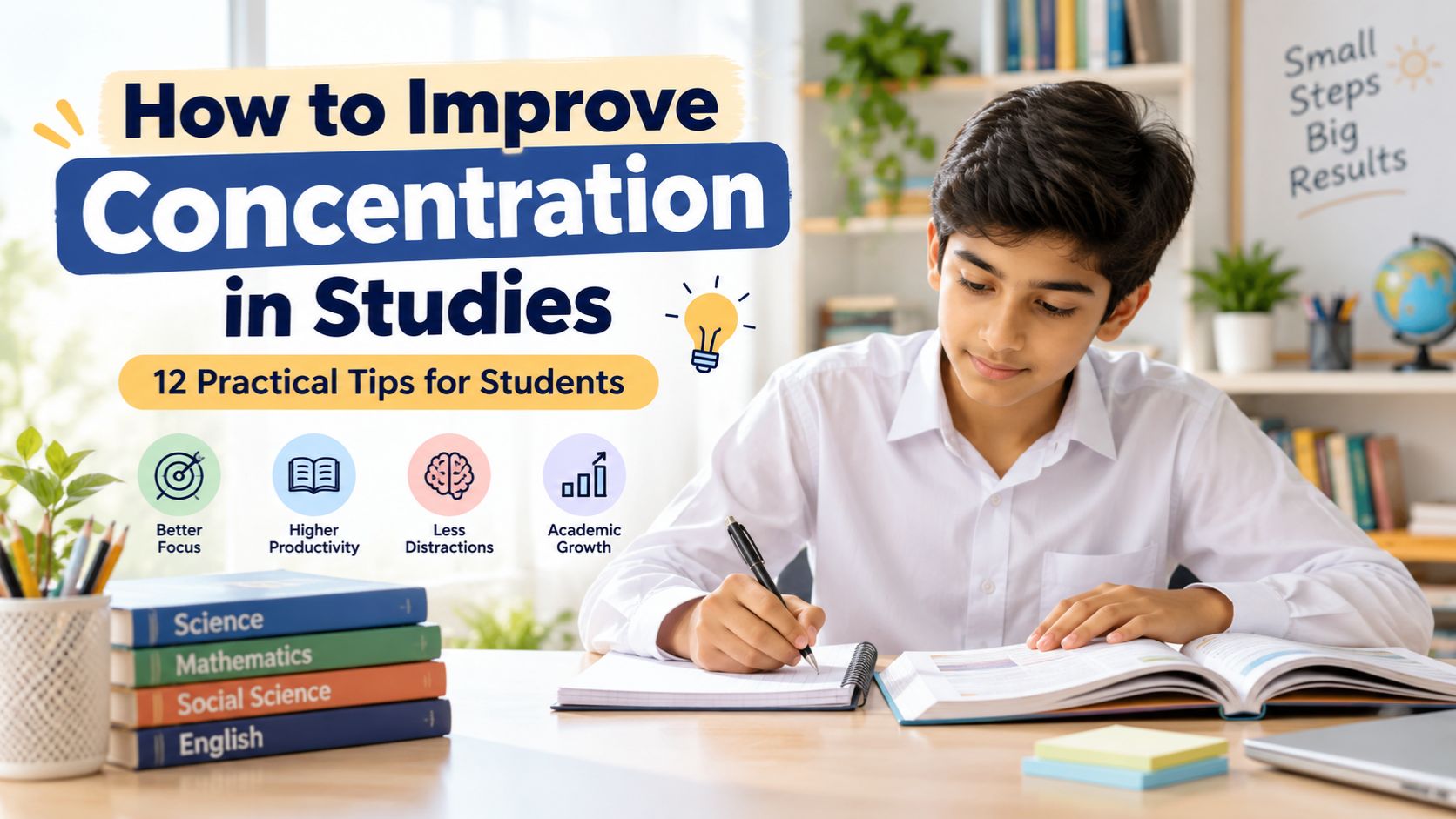
In this guide, we will explore 12 simple and practical ways to improve your concentration, complete your schoolwork more effectively, and make studying less stressful.
Concentration means giving your attention to one activity without constantly getting distracted. When you concentrate properly while studying, you can understand lessons more clearly and remember important information.
For example, imagine two students preparing for the same examination. One studies for three hours while frequently checking their phone. The other studies for one hour with full attention and follows it with a short revision session. The second student may understand and remember more because their study time is better organized.
Good concentration can help students:
Understand difficult concepts more easily.
Complete homework and assignments on time.
Remember information during examinations.
Reduce unnecessary study-related stress.
Develop confidence and independent learning habits.
Developing concentration is closely connected with building effective study habits. Students can also explore these practical study tips for school students to make their learning routines more productive.
Before trying to improve your focus, it is helpful to understand what is distracting you.
Sometimes the problem is obvious, such as a ringing phone or loud television. At other times, the reasons are less noticeable.
Common causes include excessive screen time, insufficient sleep, tiredness, examination pressure, an uncomfortable study environment, and trying to complete several tasks simultaneously.
A student may also find it difficult to concentrate when a topic feels confusing or when the amount of homework seems overwhelming.
Understanding these challenges is important because different problems need different solutions. Instead of forcing yourself to study without a break, identify what is making concentration difficult and take small steps to improve it.
Your surroundings can influence how well you concentrate. Studying in a noisy room with unnecessary items scattered around can make it difficult to pay attention.
Choose a quiet and comfortable place where you can sit properly and keep your study materials organised.
Make sure your desk has sufficient lighting, a comfortable chair, and enough space for your books and notebooks. Keep only the materials required for your current subject nearby.
You do not need an expensive study setup. Even a small, tidy corner of your home can become an effective learning space.
When you regularly study in the same place, it becomes easier to establish a consistent study routine.
 School student preparing a study timetable to improve concentration in studies
Have you ever planned to study five subjects in one evening and then struggled to complete even two?
An unrealistic timetable can leave students feeling discouraged.
Instead, create a study schedule that matches your school hours, homework, and personal activities.
Divide your study time among different subjects and leave enough space for meals, rest, and recreation.
For example, you could spend 40 minutes practising mathematics, take a short break, and then move on to science.
Try to study at approximately the same time each day. A consistent routine can reduce procrastination and make it easier to begin studying.
Students looking to improve their daily routines can read about the good habits that help students succeed
Mobile phones are useful for learning, but they can also interrupt study time.
A single notification may tempt you to check a message. A few minutes later, you might find yourself watching videos or scrolling through social media.
Before beginning your study session, keep your phone away or switch on silent mode. If you need a device for educational purposes, close unrelated applications and notifications.
You can also inform family members about your study hours so they know when you need uninterrupted time.
For more useful suggestions, explore Hera Public School's guide on how to avoid distractions while studying.
Studying continuously for several hours may leave you feeling mentally exhausted.
Instead of forcing yourself to remain at your desk, divide your lessons into manageable sessions.
One popular approach is the Pomodoro Technique. You can begin by studying for 25 minutes and taking a 5-minute break.
After completing a few sessions, take a slightly longer break.
During breaks, stretch, drink water, or walk around your room. Try to avoid activities that make it difficult to return to studying.
Remember that 25 minutes is only a starting point. Younger students may prefer shorter sessions, while older students may find longer periods comfortable.
The goal is to maintain attention without feeling overwhelmed.
Sometimes, students lose concentration because they do not know where to begin.
A goal such as "I will finish science today" may feel too large, particularly when the subject contains several chapters.
Instead, divide the work into smaller tasks.
For example, you could decide to read three pages, understand one diagram, or solve ten mathematics questions.
Once you complete one task, move to the next.
Small achievements can create a sense of progress and encourage you to continue learning.
Writing your daily goals in a notebook also helps you keep track of completed work.
 School students using group discussion and active learning techniques to improve concentration in studies
Reading the same page repeatedly does not always mean you understand it.
To stay mentally involved, try using active learning techniques.
After studying a topic, close your textbook and explain the main points in your own words. You can also create flashcards, write short summaries, or answer practice questions without looking at your notes.
For subjects like science and geography, diagrams and mind maps can help organise information visually.
Another useful method is teaching a concept to a friend. When you explain something clearly, you also get an opportunity to discover which parts you need to revise.
These activities make learning more engaging and encourage students to pay closer attention.
Sleep is important for memory, attention, and learning.
When you do not get enough rest, you may feel tired in class, struggle to understand instructions, or find yourself reading the same sentence several times.
According to the Centers for Disease Control and Prevention (CDC), children aged 6–12 should generally get 9–12 hours of sleep daily, while teenagers aged 13–18 need approximately 8–10 hours.
Try to maintain a regular bedtime and avoid using electronic devices immediately before sleeping.
Getting adequate sleep can help you feel more alert and prepared for the next day's lessons.

Did you know that physical activity can support attention and learning?
Spending the entire day sitting with textbooks is not necessary for academic success. Your body also needs movement, exercise, and recreation.
Activities such as cricket, football, badminton, cycling, and walking provide opportunities to stay active and refresh your mind.
The CDC's physical activity guidelines recommend that children and adolescents aged 6–17 participate in at least 60 minutes of moderate-to-vigorous physical activity daily. Regular activity also supports brain health and learning.
Choose activities you enjoy and make them part of your everyday routine.
Your brain needs adequate nutrition and hydration to function properly.
Skipping breakfast or studying when you are extremely hungry can make it uncomfortable to concentrate.
Try to eat balanced meals that include fruits, vegetables, whole grains, and protein-rich foods.
Common choices such as dal, eggs, milk, curd, nuts, and seasonal fruits can form part of a nutritious diet.
Keep a water bottle near your study desk and drink water regularly.
You do not need special foods or expensive supplements to become more focused. Regular, balanced meals and sufficient water are sensible habits that support overall health and learning.
Sometimes, the biggest distraction comes from your own thoughts.
You may feel nervous about an upcoming examination, worry about unfinished homework, or struggle to understand a difficult chapter.
When this happens, try a simple breathing exercise.
Sit comfortably, breathe in slowly, and breathe out gently. Repeat this for a minute or two while allowing your body to relax.
You can also close your eyes briefly and bring your attention back to the present moment.
Deep breathing is not a guaranteed solution to every concentration problem, but it can help you feel calmer before returning to your studies.
Some students try to complete homework while watching television, listening to conversations, or replying to messages.
Although it may feel like you are doing several things at once, switching between activities can interrupt your attention.
Instead, focus on one academic task at a time.
If you are practising mathematics, complete the selected questions before moving to another subject.
Similarly, when reading a chapter, avoid repeatedly switching between textbooks, messages, and unrelated videos.
Give each activity your full attention and finish one manageable task before beginning another.
This simple change can help make your study sessions more organised and productive.
Revision is essential for remembering what you have learned.
Rather than waiting until examinations are near, spend a little time reviewing previous lessons each day.
You can revise by answering questions, explaining concepts aloud, or writing important points without referring to your textbook.
At the end of your study session, ask yourself what you understood and which topics need more practice.
Celebrate small achievements, such as completing a difficult assignment or following your timetable consistently.
Do not compare your progress with that of your classmates. Every student learns at a different pace.
Concentration improves gradually, so patience and regular effort are more valuable than expecting immediate results.
Parents and teachers play an important role in helping children develop effective learning habits.
At home, parents can provide a quiet study environment, encourage regular sleep routines, and help children manage their time without creating unnecessary pressure.
Teachers can make classroom learning more engaging through discussions, practical activities, and opportunities for students to ask questions.
At Hera Public School, we recognise that meaningful education includes academic learning, personal development, discipline, and student well-being.
Our approach to education encourages curiosity, confidence, and independent learning, helping students build skills that extend beyond examinations.
When schools and families work together, students are better supported in developing concentration, confidence, and a positive attitude towards learning.
Learning how to improve concentration in studies takes time, but it does not have to be complicated.
Simple habits such as following a realistic timetable, avoiding digital distractions, taking regular breaks, getting enough sleep, and revising consistently can make studying more manageable.
Remember that concentration does not mean sitting with your books for endless hours. It means using your available time meaningfully and giving attention to what you are learning.
Start by choosing two or three tips from this guide and practising them every day. Once they become part of your routine, gradually introduce more positive habits.
At Hera Public School, we believe that every student deserves encouragement and a supportive learning environment to develop their abilities and achieve their goals.
With patience, consistent effort, and the right guidance, students can build stronger concentration and enjoy a more rewarding learning experience.