
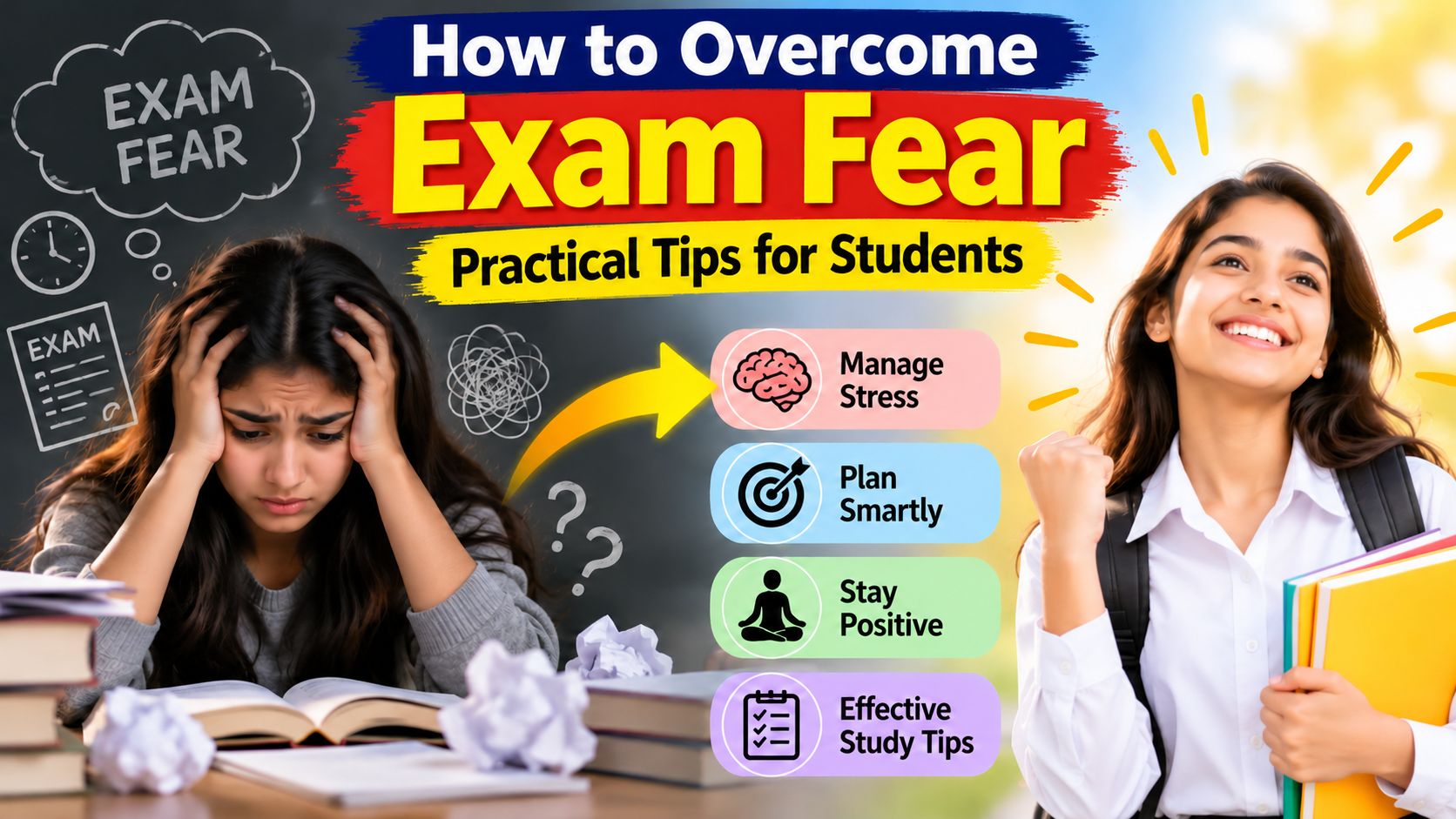
Exams are an important part of student life, but for many students, the days leading up to an examination can bring nervousness, self-doubt and stress. Thoughts such as “What if I forget everything?”, “What if the paper is too difficult?” or “What if I don't score well?” can make even a well-prepared student anxious.
The good news is that feeling slightly nervous before an exam is normal. A certain amount of pressure can even motivate students to prepare better. The problem begins when worry becomes so strong that it affects concentration, sleep, confidence or performance.
So, how to overcome exam fear and approach examinations with greater confidence? Students who are also trying to understand how to overcome exam stress should focus on preparation, healthy routines and a calm mindset rather than last-minute panic.
The answer does not lie in studying continuously for hours or trying to memorize everything at the last moment. Instead, students need a combination of smart preparation, healthy routines, realistic thinking and emotional support.
At Hera Public School, education focuses not only on academic achievement but also on the overall development of students. The school’s approach encourages confidence, discipline, independent thinking and personal growth, helping students prepare for challenges both inside and outside the classroom.
Before learning how to reduce exam stress, it is important to understand where the fear comes from.
Different students may worry about examinations for different reasons. Some are afraid of disappointing their parents or teachers, while others become nervous because they feel unprepared. Even high-performing students may feel pressure because they want to maintain their marks.
Common causes of exam fear include lack of preparation, fear of low marks, comparison with classmates, pressure from expectations, poor sleep, negative thinking, and difficulty managing time.
Recognizing the reason behind your anxiety is the first step towards controlling it. Instead of thinking, “I am scared of exams,” ask yourself, “What exactly am I worried about?”
Once you understand the reason, the problem usually becomes easier to manage.
 Student studying calmly while learning how to overcome exam fear
One of the most effective tips to overcome exam fear is also one of the simplest: do not leave everything until the last few days.
When students have a large syllabus and very little time, the brain naturally feels overwhelmed. On the other hand, studying a small portion regularly makes preparation much more manageable.
Create a realistic study schedule several weeks before your examination. Divide subjects into chapters or topics and assign manageable portions to each day.
Instead of writing:
Monday – Study Science
write:
Monday – Revise Chapter 4, complete 10 questions and review important definitions.
Smaller goals feel achievable and give you a sense of progress. Consistency usually works better than one extremely long study session.
A timetable should support you, not frighten you.
Many students make the mistake of creating unrealistic schedules such as studying for 10 or 12 hours every day. When they cannot follow the timetable, they feel guilty and their exam anxiety increases.
A better strategy is to identify the subjects that need more attention, difficult chapters, revision time, practice-paper time and proper breaks. If you are wondering how to overcome exam stress, creating a realistic study plan is one of the best places to start.
Study challenging subjects when your concentration is strongest. For some students, this may be early morning. Others may study better in the afternoon or evening.
There is no perfect timetable that works for everyone. The best study plan is one you can actually follow.
 Students using smart revision techniques to reduce exam stress
Students sometimes become afraid because they believe they must remember every sentence from their textbooks.
That is rarely an effective learning strategy.
Try to understand the concept first. Once you understand why something happens or how an idea works, remembering the information becomes much easier.
Use methods such as mind maps, flashcards, diagrams, short notes, practice questions and teaching the topic to someone else.
For example, after finishing a chapter, close the book and try explaining the topic aloud as though you were teaching a friend. If you can explain it clearly in your own words, you probably understand it well.
Fear often comes from uncertainty. Students may wonder what type of questions will come, whether they will finish the paper on time or what will happen if they get stuck on a difficult question.
Practicing previous papers and mock tests reduces this uncertainty.
Set a timer and attempt a paper under examination-like conditions. Afterwards, review your mistakes and identify the topics that need improvement.
Mock tests help students develop better time management, familiarity with question patterns, writing speed, confidence and accuracy.
Do not feel discouraged when you make mistakes during practice. Practice is exactly where mistakes should happen because they show you what to improve before the real examination.
One classmate may say, “I have revised everything three times,” while another may say, “I studied until 2 AM yesterday.”
Hearing these conversations can immediately make you feel behind, even when your own preparation is going well.
Every student learns differently.
Instead of comparing the number of hours you study with someone else, compare today’s progress with yesterday’s progress.
Ask yourself:
Do I understand this topic better than I did yesterday?
That is a much healthier measure of improvement.
Your examination is ultimately between you and the question paper, not between you and your classmates.
Studying continuously does not always mean learning more.
After prolonged concentration, the brain becomes tired and information becomes harder to absorb.
Try studying in focused periods followed by short breaks. For example, study for around 40 to 50 minutes and then take a 5 to 10 minute break.
During the break, you can stretch, drink water, walk around, relax your eyes or speak briefly with family.
Try not to spend every break scrolling through social media because a five-minute break can easily become thirty minutes.
Regular breaks make your study sessions more sustainable and can improve concentration.
Sacrificing sleep to study all night may feel productive, but it can make concentration and recall more difficult the following day.
Adequate sleep supports attention, learning and mental well-being. According to the Centers for Disease Control and Prevention, children aged 6 to 12 generally need around 9 to 12 hours of sleep, while teenagers aged 13 to 18 generally need about 8 to 10 hours.
Try to maintain a regular sleeping schedule, particularly during examination periods.
Avoid starting an entirely new chapter late at night before an important examination. Instead, revise key points, organise your materials and allow your mind to rest.
Guidance from UNICEF on dealing with exam anxiety also highlights the importance of healthy routines, enough rest and speaking to trusted adults when stress becomes difficult to manage. Students looking for practical advice on how to overcome exam stress should treat proper sleep as part of their preparation, not as wasted study time.
Getting enough sleep is also an important part of learning how to overcome exam fear effectively.
 Students practicing breathing exercises to overcome exam anxiety
Sometimes exam fear appears physically.
Your heartbeat may become faster, your hands may feel sweaty or your mind may suddenly feel blank.
When this happens, slow breathing can help you regain control.
Try this simple exercise: breathe in slowly for four seconds, hold briefly and breathe out slowly for around four to six seconds.
Repeat this several times.
While breathing, remind yourself:
“I have prepared. I will solve one question at a time.”
Avoid thinking about the entire paper before you even begin. Focus only on the question in front of you.
Exam anxiety often grows because of the way we speak to ourselves.
Consider the difference between these two thoughts:
“I am going to fail this exam.”
and
“Some questions may be difficult, but I will answer the ones I know first.”
The second statement does not pretend that the examination will be easy. It simply gives your brain a realistic and manageable way to approach the situation.
When you notice negative thoughts, challenge them.
Replace “I can't do this” with “I can start with what I know.”
Replace “Everyone is better prepared than me” with “I will focus on my own preparation.”
Confidence does not mean believing that you will know every answer. It means trusting yourself to handle the paper as effectively as possible.
Your brain works better when your body is properly cared for.
During examination season, try to maintain regular meals, drink enough water and include some physical activity in your routine.
Even a short walk, stretching session or outdoor activity can provide a useful mental break from studying.
Avoid depending excessively on caffeine, energy drinks or sugary snacks to remain awake for long periods.
Balanced habits usually support concentration much better than last-minute attempts to force yourself to stay awake.
 Confident students writing an exam after overcoming exam fear
Your exam stress management does not stop when you enter the examination hall.
Begin the morning calmly. Avoid trying to revise the entire syllabus immediately before entering the exam.
Once you receive the question paper, read the instructions carefully.
Start with questions you feel confident answering. This can help you settle into the examination and build momentum.
Keep an eye on the time, but do not check the clock every few minutes.
If a question seems difficult, leave some space and move to another question. You can return to it later.
Most importantly, do not panic when another student begins writing immediately. They may simply have started with a question they know well.
Focus on your own paper.
These simple habits can make a major difference when students are learning how to overcome exam fear and stay calm under pressure.
Students should not have to manage examination pressure completely alone.
Parents can help by providing encouragement instead of repeatedly discussing marks. Teachers can help students identify difficult topics and develop effective revision strategies.
As UNICEF explains in its guidance on how students can deal with anxiety before exams, talking to parents, teachers or another trusted adult can be especially helpful when worry begins to feel overwhelming.
At Hera Public School, students are encouraged to grow academically as well as personally. Parents who want to understand the school’s academic environment and admission process can also explore the Hera Public School admission guidelines and the school’s frequently asked questions for additional information.
Students who need academic guidance should communicate openly with their teachers rather than silently worrying about topics they do not understand.
Learning how to overcome exam fear is not about eliminating every nervous feeling. Even confident students may feel butterflies before an important examination.
The goal is to prevent those feelings from controlling your performance.
Students who want to understand how to overcome exam stress should remember that the best results usually come from steady preparation, healthy routines, realistic expectations and asking for support when needed.
Prepare consistently, revise intelligently, practise questions, sleep properly, take breaks and ask for help whenever you need it.
Most importantly, remember that one examination does not define your intelligence, your ability or your future.
Approach each examination as an opportunity to show what you have learned rather than as something to fear.
At Hera Public School, the focus on holistic education can help students develop not only academic knowledge but also confidence, discipline and the ability to face challenges positively.
Prepare sincerely, believe in your efforts and take the paper one question at a time.