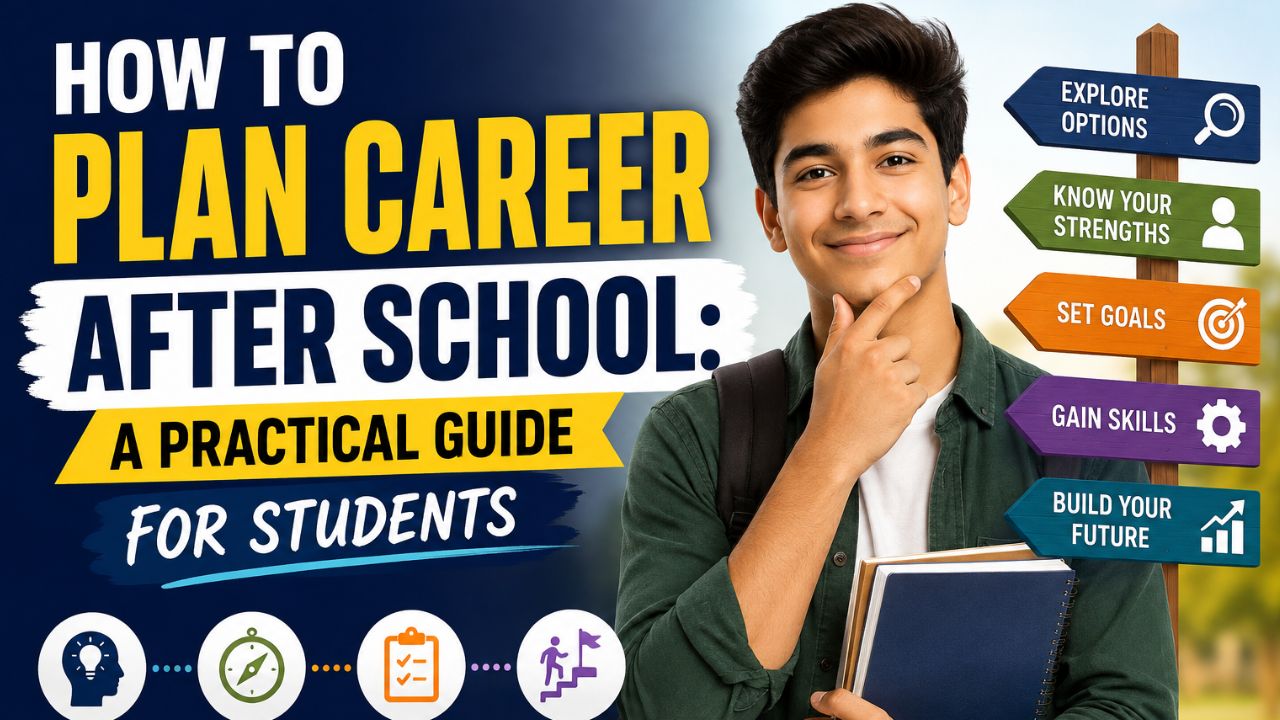
Finishing school is really exciting. It also makes you think about what you want to do next. This is a question that a lot of students have. Some students already know what they want to be, like a doctor or an engineer or a designer or an entrepreneur or a teacher or a lawyer. Other students are still trying to figure out what they like to do. That is okay.
Learning how to plan your career after school is not about making the choice when you are 16 or 18 years old. It is about getting to know yourself looking at what you can do, learning the skills and slowly moving towards a career that is a good fit for you and what you are good at.
The choices students make during their school years can influence their higher education and career journey. This is why a supportive learning environment matters. At Hera Public School, the focus goes beyond academics by encouraging curiosity, confidence, independent thinking and overall personality development. The school describes its approach as preparing students with academic and personal skills relevant to modern life while helping them grow into confident and responsible individuals.
So, if you are wondering how to choose a career after school, here is a practical step-by-step guide.
Career planning should start with you.
You are the person when it comes to planning your career.
Before you look for colleges or entrance exams or jobs that pay a lot spend some time getting to know your interests and your own abilities.
Ask yourself:
Which subjects do I genuinely enjoy?
Which activities make me curious?
Am I more comfortable working with numbers, people, machines, ideas or creativity?
Do I enjoy solving problems?
Do I like working independently or with a team?
What kind of activities make me lose track of time?
For example a student who likes Mathematics, coding and solving puzzles may want to look into technology, engineering, data science or finance. A student who likes to understand people may think about psychology, teaching, law, management or social sciences.
A student who likes to draw does not have to become an artist. There are new jobs that a student who likes to draw can do, like graphic design, animation, architecture, product design and designing things that are easy for people to use.
This is why students should start thinking about what they want to do after school by trying things rather than feeling like they have to make a decision right away. Career planning for students, after school should start with trying things not with feeling pressured.
 career planning after school for students
When students pick a career they often make a mistake by doing what their friends do.
For example let us say five friends want to study for engineering entrance examinations.
Then a sixth student joins them. This student is only doing it because their friends are doing it.
This sixth student might actually want to study economics or law or design.
This is not how you should choose a career.
Your friends are all different from you they have things they like and dislike they are good at different things they have different amounts of money and they want different things for their future.
A career that is great for one person might be very frustrating for another person.
Parents and teachers can give you advice but you should also think carefully about what you want to do.
You should not try to pick the career that the most people want.
Your goal is to pick a career path that's right for you after you finish school.
The career you choose should be an one, for you.
3. Explore Different Career Options
Students often know about only a limited number of professions.
Doctor.
Engineer.
Teacher.
Lawyer.
Government officer.
These are excellent careers, but the professional world is much larger today.
Students can explore career opportunities in areas such as:
Artificial Intelligence
Cybersecurity
Data Science
Biotechnology
Psychology
Architecture
Digital Marketing
Financial Analysis
Sports Management
Hospitality
Animation
UI/UX Design
Journalism
Environmental Science
Entrepreneurship
Public Policy
Agriculture Technology
Logistics and Supply Chain Management
Before deciding, understand what professionals in different fields actually do.
The Government of India’s National Career Service offers career-related information and resources for students and jobseekers. Its career information repository includes descriptions of different job roles and sectors, which can help students discover professions they may not previously have considered.
Similarly, career-resource collections provide information across fields ranging from engineering, medicine and commerce to computer science, design, sports, hospitality, agriculture and social sciences.
The more careers you explore, the better your chances of discovering something that genuinely matches your abilities.
Marks are important. They should not be the only thing you think about when you are deciding what you want to do in the future.
You might be good at Mathematics. Get high marks in it but you might actually like writing stories or poetry more.
Another student might not get the marks in class but they might be really good at talking to people leading a team or working with computers.
Look at what you're really good at overall look at your broader strengths like what are your strengths, in general what are your strengths outside of just marks look at your broader strengths.
They may include:
Analytical skills: solving problems and working with numbers.
Communication skills: speaking, presenting and explaining ideas.
Creative skills: drawing, writing, designing or generating ideas.
Leadership skills: organising people and taking responsibility.
Technical skills: coding, repairing, building or understanding technology.
Interpersonal skills: listening, supporting and working with others.
Schools play an important role in helping students identify these strengths. Hera Public School states that its learning environment aims to develop qualities such as curiosity, imagination, confidence and independent lifelong learning rather than concentrating only on intellectual development.
These abilities can become important clues while deciding what to do after school.
Your school subjects can provide a starting point for career exploration.
Students interested in Physics, Mathematics and technology may investigate careers related to engineering, computing, architecture or scientific research.
Students interested in Biology may explore medicine, biotechnology, pharmacy, nutrition, physiotherapy, life sciences or environmental science.
Students who enjoy Economics, Accountancy and Business Studies may explore finance, management, entrepreneurship, banking, economics and business analytics.
Those who enjoy History, Languages, Political Science or Sociology may explore law, journalism, civil services, teaching, communications, international relations and social sciences.
However, avoid thinking that every subject leads to only one profession.
Modern careers are increasingly interdisciplinary.
Technology combines with finance.
Design combines with engineering.
Psychology combines with marketing.
Biology combines with data science.
Your school stream can provide direction, but it does not necessarily define your entire professional life.
Students sometimes do the opposite.
They first decide, “I want admission to this famous college,” and only afterwards check the available course.
Career planning should ideally begin with the course.
Ask:
What will I study?
What skills will I gain?
What higher-study options will I have?
Which careers can this qualification lead to?
Is practical training included?
Are internships available?
Only after answering these questions should you compare universities or colleges.
Official career resources can also help families understand higher-education pathways. Career-resource collections available for students cover areas including engineering, medical sciences, commerce and finance, design, computer applications, law, economics, hospitality and vocational studies.
This kind of research makes career planning after Class 12 much more informed. how to choose career after school
Many professional courses need entrance exams. Students who want to have jobs should learn about the exam requirements early instead of finding out just before they finish school.
Make a table with:
Career goal- Required course -Entrance examination- Eligibility- Preparation timeline. Learning this early can help students plan their study without much stress at the last minute.. Career preparation should not be just about passing exams.
Entrance exams are one part of the journey. Understanding ideas speaking being disciplined, solving problems and being emotionally ready are just as important, for long-term success.
Good marks may help you enter a college.
Good skills help you succeed beyond it.
Students should begin building practical abilities while they are still in school.
Useful skills include:
Communication
Public speaking
Writing
Digital literacy
Basic coding
Research
Problem solving
Critical thinking
Leadership
Teamwork
Time management
Suppose two students complete the same degree later.
One person only has qualifications.
The other person has done a lot of things like projects ,presentations ,competitions and internships ,volunteering and activities to develop skills.
This student may have an idea of how to use what they learn in real life not just what is, in the textbooks because they have done so many things outside of school like the projects and the volunteering and the internships and the competitions.
At Hera Public School, the stated educational approach includes intellectual, social, cultural, physical and personal development, with teachers also serving as mentors and role models.
A balanced school experience can therefore form an important foundation for future career readiness.
Google can tell you what a profession is.
A professional can tell you what it actually feels like.
If you are interested in medicine, speak to a doctor.
Interested in technology? Talk to a software professional.
Thinking about entrepreneurship? Speak with someone running a business.
Ask them:
What does a normal workday look like?
What qualifications are required?
What are the difficult parts of the profession?
Which skills are most important?
What would they do differently if they were starting again?
Even a short conversation can remove many unrealistic assumptions about a career.
Career counselling can also help students connect their interests, abilities and education options. The National Career Service describes career counselling and career information among the services available through its platform and associated career centres.
Sometimes the best way to understand a career is to experience a small part of it.
Students can participate in:
School projects
Science exhibitions
Coding competitions
Debates
Sports
Creative competitions
Community activities
Workshops
Short internships
Online skill courses
Entrepreneurship projects
A student interested in journalism might start writing articles.
Someone interested in programming can build a simple website.
A future entrepreneur may try creating and selling a small product.
A student interested in teaching could volunteer to help younger students understand a subject.
These experiences make career decisions more realistic because students discover what they actually enjoy doing. career guidance activities for students
Salary is important, but choosing a profession only because someone says it pays well can lead to poor decisions.
Instead, investigate:
Long-term growth opportunities
Skills required
Work environment
Career stability
Future demand
Opportunities for specialization
Work-life expectations
Possibility of entrepreneurship
Higher-study options
A good career should ideally offer a combination of personal interest, ability, growth and financial sustainability.
Remember that your first salary will not define your entire career.
Skills improve.
Experience grows.
Industries change.
New opportunities appear.
Think about where a career can take you over ten years—not just what the first job might pay.
Once you have researched your options, create a simple plan.
For example:
Goal: Become a software engineer.
School focus: Mathematics, computers and logical reasoning.
Skills: Coding, communication and problem solving.
After school: Pursue an appropriate technology-related degree.
During college: Build projects and participate in internships.
Long-term: Explore software development, AI, cybersecurity or another specialization.
Your plan does not need to remain permanent.
At 17, you may believe one career suits you.
At 20, after gaining more experience, you might discover another field that suits you even better.
Changing direction after learning more about yourself is not failure.
Career planning is a process.
Parents naturally want stability and success for their children.
Career conversations become more productive when they are discussions rather, than instructions.
Parents can ask:
"What subjects do you enjoy?"
"What kind of work interests you?"
"What careers have you researched?"
"What support do you need?"
Students should also listen carefully to their parents because adults may notice strengths, weaknesses or practical considerations that students overlook.
The best decisions often happen when students, parents and teachers communicate openly.
Many school students feel worried when their classmates confidently announce their future plans.
“My friend already knows she wants to become a doctor.”
“My cousin has started preparing for engineering.”
“Everyone seems to know what they are doing except me.”
Do not turn career planning into a race.
Being uncertain simply means you need more exploration.
Start with three possible career areas instead of trying to identify one perfect profession immediately.
Research them.
Talk to professionals.
Try relevant activities.
Compare courses.
Understand your strengths.
Gradually, your direction becomes clearer.
Learning how to plan career after school is ultimately about making informed decisions—not rushed ones.
A student’s future preparation begins much earlier than college applications.
Confidence, curiosity, discipline, communication, independent thinking and values develop gradually throughout school life.
Hera Public School explains that its educational vision focuses on both academic learning and personal development, encouraging students to develop curiosity, imagination, confidence and independent learning abilities. Teachers are also positioned as educators, role models and mentors who support students throughout their development.
Families interested in learning more about the school can explore the Hera Public School website or read more about its educational philosophy on the About Us page.
Students seeking admission can also review the school’s Admission Guidelines, which provide information regarding the application and admission process. career guidance at Hera Public School
Planning a career after school may feel like a huge responsibility, but students do not need to have their entire life figured out immediately.
Start by understanding yourself.
Explore careers.
Research courses.
Build useful skills.
Speak with teachers, parents and professionals.
Get practical exposure.
Then make the best decision you can with the information available.
Most importantly, remember that careers are built gradually.
The student who remains curious, keeps learning and adapts to new opportunities will often be better prepared for the future than someone who simply follows the most popular career option.
At Hera Public School, education aims to help students develop the knowledge, values, confidence and independent learning skills needed to face the future with greater clarity.
Your career does not begin after school.
The preparation for it begins with every skill you develop, every question you ask and every opportunity you explore today.