
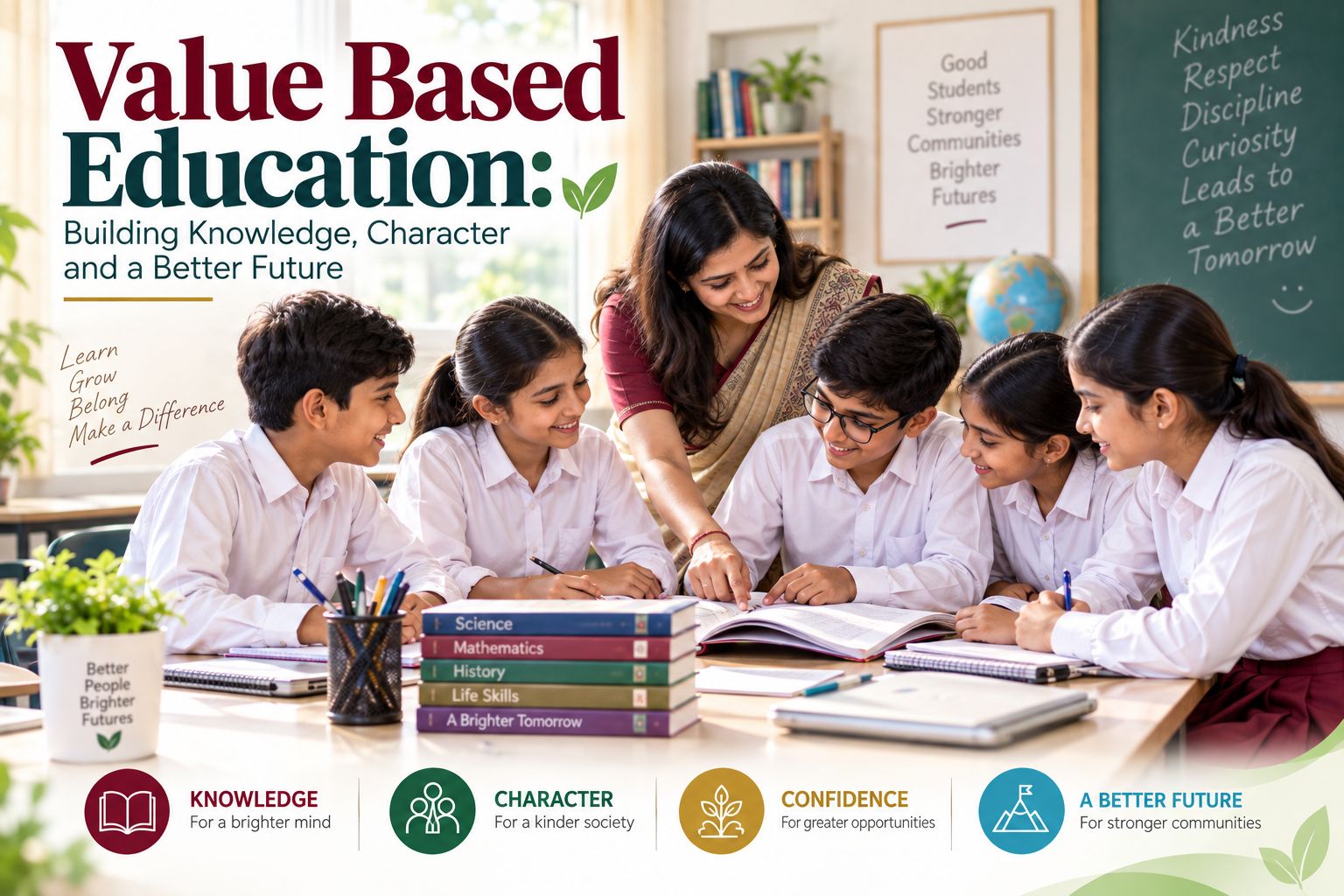
Education has been linked to books, tests, scores and academic success. All these aspects are still significant but the essence of education is more than these.
A child might be educated about math, science, languages and technology but the education system should also educate the child about values like honesty, responsibility, compassion, respect and sense of good and bad.
Here comes the concept of Value Based Education.
Value Based Education is the combination of academic and character building education where children are not only trained for exams but also prepared for practical life situations, building relationships, decision-making and contributing to society in an effective way.
When the world is progressing at a fast pace and kids are getting exposed to technology, social media, competition and information at a very young age, then academic education might not be sufficient anymore. They require principles too which will help them during tough times.
It is the responsibility of schools to do this.
At Hera Public School, Azamgarh, education reflects this broader approach to learning. Along with academic development, the school emphasizes qualities such as discipline, empathy, responsibility, integrity, respect and service towards society.
Because ultimately, successful education is not simply about what a student knows. It is also about the kind of person that student becomes.
 Value education in schools teaching students teamwork, responsibility, empathy and respect through classroom activities
 Value Based Education is an educational strategy in which the moral, ethical, social and personal values are instilled in a child throughout the whole educational process.
This type of education does not mean that there should be a textbook in the curriculum with the title "Values".
It can be incorporated into the daily activities of schools.
For instance, when students practice waiting for their turn, they learn patience.
While working on projects in groups, they learn teamwork.
Accepting the responsibility for their mistakes, they learn honesty.
Helping another student who has difficulties, they learn empathy.
Respecting their teachers, parents, other students and supporting personnel, they learn about dignity and mutual respect.
Consequently, value education in schools is not confined only to telling children what is right and what is wrong.
It means helping them to practice positive values on a regular basis.
In the long run, this may affect their personality and lifestyle.
The children of today are brought up in a totally different environment compared to past generations.
Information is available in an instant. Social media dictates views and attitudes. Technology and artificial intelligence are changing the ways in which people study and work. Competition is becoming fiercer and children are pressured to perform at school from an early age.
In such an environment, education must offer something that technology will not be able to offer - a moral compass.
Knowledge informs the student about what is possible.
Values will guide the student about what is responsible.
Technology will make the person capable.
Values will decide on how this capability will be employed.
One of the key motivations behind the rising relevance of Value Based Education is here.
The students need the freedom of thought while being responsible for themselves. They need the skills to compete responsibly, communicate respectfully, and succeed in life without forgetting their responsibilities to their family and to the society.
Such an education will help the child understand that success and personality grow hand in hand.
Although values may be expressed differently across cultures and communities, several qualities are universally important for the healthy development of children.
Honesty enables students to learn the value of being truthful and honest.
At school, honesty could be doing one’s own work, admitting mistakes, not cheating and communicating honestly.
Students who have learned honesty realize that accomplishing things honestly has more value than succeeding by taking shortcuts.
Respect starts when we acknowledge the worth of other people.
Students need to learn how to respect their teachers, parents, other students, and even themselves.
It is also an environment where children can air their differing views without having arguments turn into fights.
Through responsibility, one learns that his or her actions bear results.
Assignments being done on time, respect for school property and abiding by the rules are easy methods of acquiring the habit of responsibility.
Ultimately, these will help to prepare the students for college, their profession and future responsibilities.
Empathy is the ability to understand how another person may feel.
A child who develops empathy becomes more willing to help others, listen carefully and respond sensitively.
In a diverse society, empathy can help build stronger relationships and reduce unnecessary conflict.
Discipline is often mistaken for punishment. However, discipline, in educational settings, is more focused on self-discipline.
It involves setting routines, organizing one’s time, managing one’s urges, being consistent, and knowing limits.
With discipline, a student eventually acquires responsibility for his or her own learning without relying entirely on outside supervision.
Compassion encourages students to care about people beyond themselves.
Helping someone in need, supporting a struggling classmate or participating in community initiatives can show students that their actions can positively affect another person's life.
Failure and disappointment are part of life.
Students therefore need to understand that one poor result or unsuccessful attempt does not define their ability.
Perseverance encourages children to reflect, improve and try again.
There is sometimes a misconception that schools must choose between academic excellence and character education.
The two can actually strengthen each other.
Consider some of the qualities required for academic achievement:
Discipline helps students follow study routines.
Honesty encourages genuine learning instead of shortcuts.
Responsibility helps students complete assignments.
Perseverance encourages them to continue after setbacks.
Respect creates healthier teacher-student relationships.
Cooperation improves group learning.
Curiosity encourages deeper understanding.
In other words, many of the values developed through value based learning also support better academic behaviour.
A student who becomes responsible for his or her own learning is likely to approach academics differently from someone who studies only because of external pressure.
The goal should therefore not be to separate academic development from character development, but to create an educational system where both complement each other.
Values become meaningful when children experience and practise them.
Schools can integrate them into everyday learning in several ways.
Teachers may relate topics taught in the class with the real world and moral issues.
Literature lessons can help develop discussions on issues like bravery, compassion, and honesty.
History may help students learn about issues like leadership, justice, and social responsibility.
Science lessons may help students become more curious about science while also teaching them about environmental responsibilities.
These practices help students develop an understanding of values as things that have real connections with the outside world.
 Teacher promoting character development and value based education through positive interaction with students
Children tend to notice behavior more than adults sometimes realize.
When students are constantly reminded to show respect for others yet see others being disrespectful all the time, the lesson is undermined.
Thus, teachers assume a very vital role as mentors and role models.
A teacher who listens patiently, treats students fairly, admits to making mistakes and communicates in a respectful manner practices values without even lecturing them.
The relationship between students and teachers can turn out to be one of the most powerful modes of character education.
 Holistic education and character development through sports, teamwork and leadership activities at school
Activities like sports, debates, cultural programs, clubs and group activities offer practical ways of teaching core values.
Sports can teach discipline, teamwork, and coping with win or loss.
Debates can enable students to communicate their opinions boldly without disregarding other people’s point of view.
Creative activities can help them become patient and expressive.
Leadership positions can help them learn about responsibility and making decisions.
Community activities can make them empathic and socially responsible.
This is the reason why holistic education goes beyond the classroom.
Schools are a vital element, although it is not necessary that all the values be imparted at schools.
Home is the first place of learning.
All these messages given to children by their parents, teachers, and society should complement each other.
Values like morality can be incorporated into education by parents in very simple and easy manners.
Promising and keeping those promises teach reliability.
Respecting others and their property teaches respect.
Admitting faults teaches the value of honesty.
Offering help without any expectation of return teaches compassion.
Providing proper guidance teaches discipline.
Making children solve the problems themselves teaches responsibility.
In this way, when parents and schools both combine, it would make the values more significant for the children.
Therefore, proper communication between parents and teachers can play a crucial part in overall development of the children.
There is a distinct difference between knowing a value and living it.
While most students know that honesty is the best policy,
The challenge is whether they will be honest even when being honest may not be easy.
Most students know that they are supposed to respect others.
The challenge lies in showing respect in times of disagreement.
Responsibility is something that most students know about.
However, the challenge lies in taking responsibility for one’s own actions.
Thus, Value Based Education that is effective should facilitate reflection and practical application of values by the learners.
The schools should give students a chance to ask themselves questions such as:
Was my conduct just?
Did I act in this case differently than what I would normally do?
How did my behavior impact the other person?
What lesson can I learn from this mistake?
Leaders of tomorrow are found in classrooms of today.
However, leadership is more than having the ability to communicate well and occupy a position of status.
Being a responsible leader requires one to have integrity, empathy, courage, ability to communicate and accountability.
Learning how to be responsible for one’s actions prepares one for leadership.
Having the ability to listen to other people's point of view prepares one for leadership.
Being able to work as part of a team instead of working selfishly prepares one for leadership.
Being able to make tough decisions when it comes to doing the right thing prepares one for leadership.
It therefore follows that character education is closely related to development of responsible leaders.
Institutions of learning should therefore seek to produce not only high achievers but also responsible learners.
Education is essentially training for life outside the classroom.
When the students join the world of professional practice, there will be cases when there is no right answer in any text book.
There may be conflict resolutions.
There may be issues of convenience versus integrity.
There will be dealing with people from different cultures and societies.
There will be failures.
And they will end up as managers, entrepreneurs, doctors, engineers, teachers, civil servants or community leaders making decisions on behalf of other people.
The academic learning equips them technologically.
The values equip them personally and socially.
In Hera Public School of Azamgarh, the educational concept does not stop with academic results alone.
The educational concept at Hera Public School is about a balanced approach to modern learning and personality building through values. Students must be able to think well while developing qualities such as honesty, discipline, compassion, responsibility and respect.
Also, the educational concept at the school includes holistic education that integrates class learning, personality building, leadership development, community interaction and co-curricular activities.
Starting from basic learning through secondary and higher levels, the aim is to build in students the skills and values that will help them for the rest of their lives.
As Hera Public School understands that children have intellectual, social, personal and spiritual aspects of development,education assumes greater significance when all of these aspects of development are considered together. This is the essence of a simple idea that education should not just be aimed at earning a livelihood but also living one's life with meaning, purpose and integrity.
The impact of values may not always be visible immediately.
A mathematics test can provide a score within a day.
Character develops over years.
However, the long-term benefits of value education can extend far beyond school.
Students with strong values may become more responsible decision-makers.
They may develop healthier relationships.
They may become more resilient when facing difficulties.
They can learn to respect differences without losing confidence in their own principles.
They may become more aware of their responsibilities towards society.
Most importantly, values can continue guiding individuals long after they have forgotten individual chapters from their textbooks.
Education therefore leaves its strongest legacy when the lessons learned in school influence the choices students make throughout life.
The purpose of education has never been limited to collecting marks, certificates and qualifications.
Those achievements are valuable, but they form only part of a child's development.
True education should help a student think clearly, communicate confidently, act responsibly and treat other people with dignity.
That is why Value Based Education has an important place in modern schooling.
When academic excellence is combined with honesty, discipline, empathy, responsibility, compassion and respect, students receive something far more valuable than examination preparation.
They receive preparation for life.
At Hera Public School, the focus on learning, values and holistic development reflects the belief that schools have the responsibility to nurture knowledgeable individuals as well as people of character.
Because the most meaningful outcome of education is not simply a student who knows more.
It is a student who can use that knowledge wisely, responsibly and for the betterment of society.
Take the Next Step Towards Meaningful Education
Choosing a school is not only about choosing a curriculum. It is about choosing an environment that will influence how your child learns, thinks, behaves and grows.
Discover how Hera Public School, Azamgarh combines academic learning with character development, strong values and holistic growth to prepare students for a confident and responsible future.
Explore Hera Public School and learn more about its educational approach and programs.