
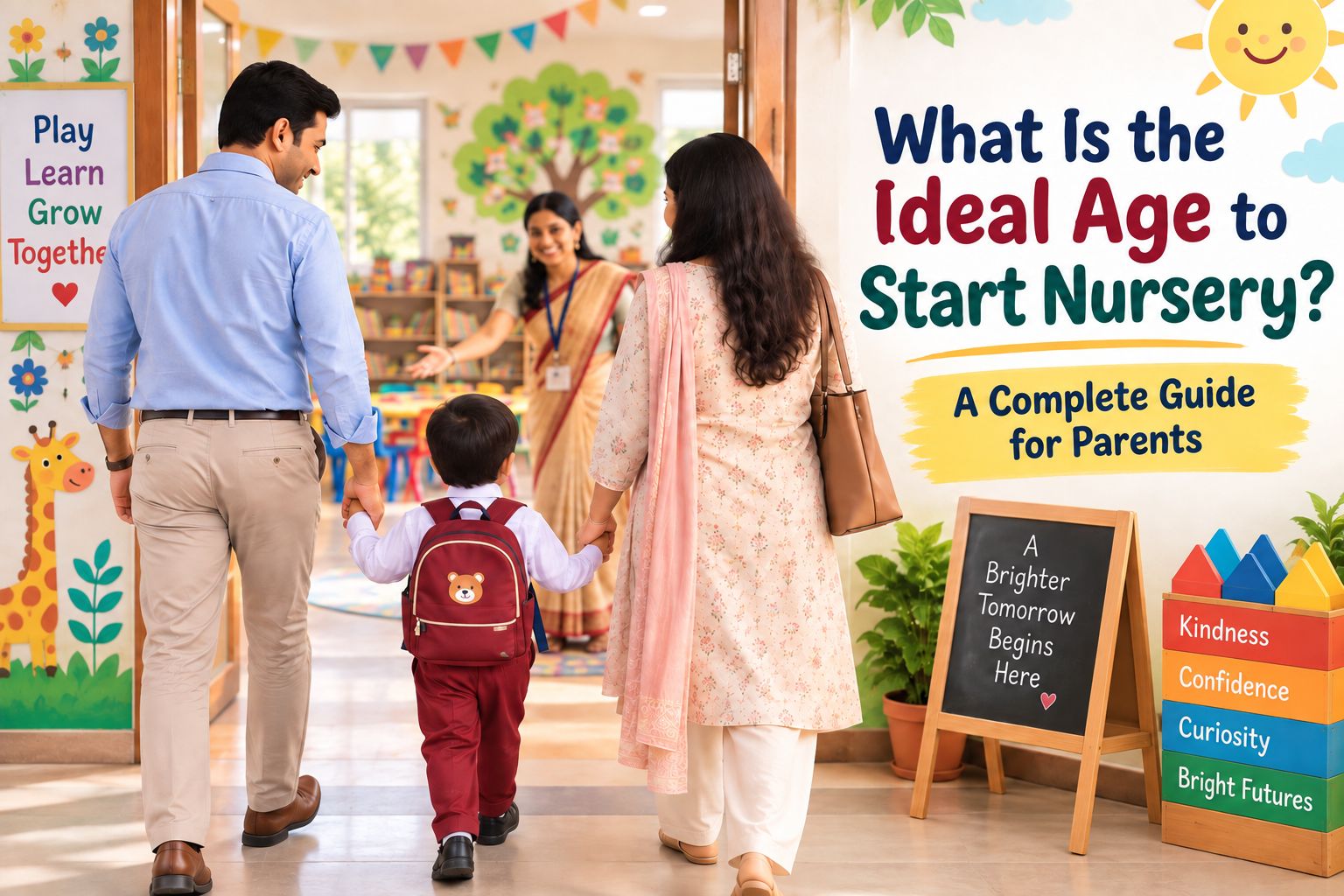
One of the earliest and major educational choices that parents have to make is when their child begins schooling. As the age of the three-year-old comes near, queries tend to arise. Is my child ready for the nursery class? Is three years too soon? Should I wait a year more? At what age is the right time to join nursery?
For most children, three years is usually considered a reasonable age for joining nursery or preschool. But then age should not be the only criterion. The development of the child emotionally and socially is just as significant as age itself. Every child develops at a different pace.
The National Curriculum Framework for the Foundational Stage of India considers ages 3–8 as a critical stage of organized foundational education, where most children begin spending considerable time in preschools after three years of age.
For parents selecting a school for their child, then, the issue is not merely “Has my child become three years old?” The real question also should be “Is my child prepared to enjoy, participate, and benefit from the school environment?” This guide covers all these issues and tells when and how to enroll your child in a nursery school.
This question may be answered quite simply, as about 3 years old is the right age to begin nursery.
For Hera Public School, admission is possible for children aged at least three years, while the Mont 1 Admission Guidelines from the school indicate that the age of eligibility ranges from 3 to 5 years. It is necessary for parents to check the right admission criteria for that specific academic year.
You can review the latest Hera Public School Admission Policy & Procedure here. Hera Public School Admission Guidelines
Starting nursery at around three years gives many children an opportunity to gradually move from a completely home-based environment into one where they interact with teachers, classmates, activities, routines and age-appropriate learning materials.
But parents should remember an important point:
The right nursery age is a guideline, not a guarantee of readiness.
Two children of exactly the same age may behave very differently. One three-year-old may happily enter the classroom, communicate needs and join group activities, while another child may need more time to adjust.
That is completely normal.
Why Is Age 3 an Important Stage for Early Learning? Ideal age for nursery admission and early childhood learning
The period preceding primary education is a very crucial period of development.
As per India’s National Curriculum Framework for Foundational Stage, the first eight years are vital for physical, cognitive and socio-emotional development. The national curriculum framework also emphasizes that children develop at different paces and their early education should cater to that aspect.
Around the age of three, most children show considerable development in various areas.
They may become curious about other children, learn to speak in sentences, learn to mimic grownups, respond to simple commands, explore objects on their own, and be fond of stories, songs, colours, and imaginary play.
An effective nursery curriculum should make use of such natural behaviors to encourage learning.
Instead of turning early education into formal academic pressure, nursery should create opportunities for children to learn through:
Play
Conversation
Stories
Music and rhymes
Art and craft
Movement
Games
Exploration
Interaction with other children
Everyday routines
This is why selecting the right school environment matters just as much as choosing the right age.
Sometimes, parents get under the impression that nursery education implies that their kid should instantly begin writing alphabets, numbers and filling out worksheets.
It is definitely not what early childhood education is all about.
Nursery marks the start of a more extensive period of development.
The right kind of nursery environment allows children to develop such qualities as communication skills, self-reliance, curiosity, coordination, self-confidence and social skills.
At this stage, something as trivial as returning toys to their place after playing will instill a sense of responsibility.
Listening to a story told by a teacher improves concentration.
Sharing of crayons will improve social skills.
Rhyme singing will improve language and memory.
Building blocks will improve coordination and imagination.
Parents exploring education options can also learn more about the programmes offered at Hera Public School. Explore HPS Programmes
If you are wondering what is the ideal age to start nursery, age gives you a starting point. Readiness tells you whether the child is comfortable making the transition.
You do not need to create a formal examination at home. Instead, observe your child naturally.
A nursery-going child does not need perfect speech.
However, it is helpful if the child can communicate basic needs using words, gestures or simple sentences.
For example:
“I want water.”
“I need help.”
“I want to go to the toilet.”
“I am hungry.”
Children develop language at different speeds, so the objective is not perfect vocabulary. The important factor is whether they have some ability to express themselves to another adult.
Separation anxiety is common when children first start nursery.
Even confident children may cry during the first few days.
The question is not whether your child ever becomes upset when you leave. Instead, think about whether the child can gradually settle with another trusted adult.
If your child has previously spent time with grandparents, relatives or caregivers without you being constantly present, adjusting to nursery may become easier.
Around nursery age, children often begin becoming increasingly interested in peers.
They may not immediately understand sharing or cooperative play, but they may enjoy sitting near other children, copying them or participating in simple group activities.
Nursery provides regular opportunities for these interactions.
Over time, children learn skills such as waiting for their turn, listening to others and working together.
Simple classroom routines become easier when children can understand directions such as:
“Please sit here.”
“Keep the toy in the basket.”
“Bring your bottle.”
“Wash your hands.”
Children do not need to follow instructions perfectly. Nursery itself helps develop listening and routine-following skills.
Curiosity is one of the strongest foundations for early learning.
Does your child ask questions?
Do they inspect new objects?
Do they enjoy looking at pictures?
Do they listen to stories?
Do they experiment with blocks, toys or colours?
If yes, these are positive signs that the child may enjoy a stimulating nursery environment.
Parents sometimes worry that their child must already know alphabets, numbers, colours and shapes before admission.
Usually, that should not be the priority.
Nursery exists partly to help children develop those early concepts.
Before beginning nursery, it is more useful for a child to have some basic everyday abilities such as eating with reasonable independence, communicating common needs, following basic routines, interacting with adults and attempting simple self-care tasks.
Even these abilities develop gradually.
Parents should avoid comparing their child with another child of the same age. One child may speak earlier while another develops excellent physical coordination. Another may initially be shy but become extremely expressive once comfortable.
Early childhood development is not a race.
 Signs that a child is ready to start nursery school
A good nursery programme develops the whole child rather than focusing exclusively on academics.
Children learn through stories, conversations, songs, rhymes and interaction.
They gradually build vocabulary, listening abilities and confidence in expressing themselves.
Children begin understanding concepts such as more and less, big and small, shapes, patterns, grouping and basic numbers through practical activities.
Nursery teaches children how to interact with people outside their immediate family.
They gradually understand sharing, turn-taking, cooperation and appropriate behaviour in groups.
Running, jumping, balancing, colouring, holding objects, building blocks and other activities develop both gross and fine motor skills.
Drawing, music, storytelling, pretend play and craft activities encourage children to imagine and express themselves freely.
Perhaps one of nursery’s most valuable contributions is helping children recognize emotions, deal with minor disappointments and become comfortable in unfamiliar situations.
Simple routines can introduce children to cleanliness, respect, responsibility, discipline, kindness and consideration for others.
Hera Public School emphasizes holistic education, quality learning and values as part of its wider educational approach.
Parents can also explore the school’s extracurricular activities to understand how experiences beyond textbooks contribute to student development. HPS Extracurricular Activities
Some children attend daycare, playgroups or early learning centres before they turn three.
That does not automatically mean they should enter a more structured nursery programme early.
Children under three generally benefit greatly from responsive care, interaction, movement, conversation, play and a secure environment. The National Curriculum Framework distinguishes the birth-to-three period from organized preschool education beginning after age three.
If parents are considering starting formal nursery significantly earlier, they should examine whether the programme is genuinely age-appropriate.
An early childhood classroom should not place young children under pressure to sit silently for long periods, complete excessive worksheets or memorize large amounts of material.
Early learning should feel like meaningful exploration.
Parents should not panic.
A child beginning preschool education somewhat later does not automatically mean they will struggle academically.
Children develop at different rates, and many factors—including family circumstances, health, relocation and access to schooling—can affect when formal schooling begins.
If your child is already four or approaching five, contact the school directly and ask which level is appropriate according to the child’s age and admission rules.
The objective should be proper placement rather than rushing the child through levels simply to “catch up.”
Once you decide that your child is ready, you can make school feel familiar rather than frightening.
Children will be more comfortable if their daily routine is predictable.
Two weeks before school starts, have regular wake-up times, breakfast, dressing, playtime, and nap times.
This makes it easier to adjust to the school schedule.
Tell your child that school is a place where they will meet teachers, make friends, listen to stories and play.
Avoid repeatedly saying things such as:
“Don't cry at school.”
“You have to stay there without me.”
“Your teacher will punish you if you don't listen.”
Even when parents mean these statements harmlessly, they may make school sound threatening.
Allow your child to carry their bottle, put toys away, open a lunch box or wear simple clothing with limited assistance.
Small tasks develop independence and confidence.
Reading aloud is one of the easiest ways to prepare a child for learning.
Choose colourful picture books and ask simple questions:
“What is this?”
“Where is the dog?”
“What do you think happens next?”
Do not turn reading into a test. Make it enjoyable.
Play dates, cousins, neighbourhood friends and community activities can help children become comfortable interacting with others.
They learn that toys are shared, other children also have opinions and sometimes they need to wait.
Seeing the classroom, playground or campus before the first day can reduce uncertainty.
Children often fear unfamiliar places more than school itself.
Knowing what is the ideal age to start nursery solves only half the problem. Parents also need to choose the right learning environment.
When comparing nursery schools, consider the following factors:
Children should feel physically and emotionally secure.
Classrooms should be appropriate for young learners, and adults should interact with children patiently and respectfully.
At nursery age, the teacher-child relationship matters enormously.
Young children learn better when they feel understood and comfortable.
Look for a programme where stories, games, conversation, movement, creativity and practical experiences are part of everyday learning.
Avoid environments that treat nursery like a competitive examination preparation centre.
Early childhood learning happens through experience.
Activities, sports, art, music and social interaction all contribute to development.
A good school understands that learning and emotional well-being are connected.
Parents interested in this area can explore Hera Public School’s Student Health and Wellness information. Student Health and Wellness at HPS
Parents and teachers should be partners.
Regular communication helps both sides understand the child's behaviour, learning and adjustment.
Starting school is exciting, but parents can unintentionally make the transition stressful.
One common mistake is comparing children.
“Your cousin already knows A to Z.”
“Your friend's daughter doesn't cry at school.”
“Why can't you write your name yet?”
Comparisons rarely motivate very young children. Instead, they can make learning feel like competition.
Another mistake is focusing too heavily on academics.
Children entering nursery do not need months of tuition beforehand.
Similarly, parents should not expect instant independence.
A child may happily attend school on day one and cry on day three. Another child may need several weeks before becoming comfortable.
Adjustment is a process.
Parents should focus on consistency, reassurance and communication with the teacher.
Nursery may look simple from the outside—stories, songs, play, colours and activities—but these experiences serve an important developmental purpose.
A positive first experience of school can shape how a child sees learning.
If children associate school with curiosity, encouragement and discovery, they are more likely to participate confidently as education becomes more structured.
This is one reason parents should think beyond questions such as “Which school teaches the most worksheets?”
The better question is:
Which environment will help my child enjoy learning while developing the skills needed for the years ahead?
Hera Public School describes its vision around quality education, strong values and equal opportunities, with an emphasis on intellectual, social and ethical growth.
Parents looking for nursery or school admission in Azamgarh can visit the Hera Public School website to learn more about the school, its academic environment and admission process. Visit Hera Public School
So, what is the ideal age to start nursery?
For most children, around three years is an appropriate age to begin nursery or preschool education, provided the child is developmentally ready for the transition.
Parents should consider both:
Age + Readiness
Look at whether your child can communicate basic needs, interact with adults and children, follow simple routines, spend some time away from parents and show curiosity about the world.
Most importantly, choose a school where early education is nurturing, engaging and developmentally appropriate.
At Hera Public School, the published admission rules provide for admission from age three, and its Mont 1 admission guidelines specify an age band of 3–5 years. Since admission criteria can be updated for different academic sessions, parents should verify the latest eligibility requirements before applying.
The goal of nursery should never be to push children into academics too quickly.
It should be to give them a happy, confident and meaningful beginning to a lifelong journey of learning.